
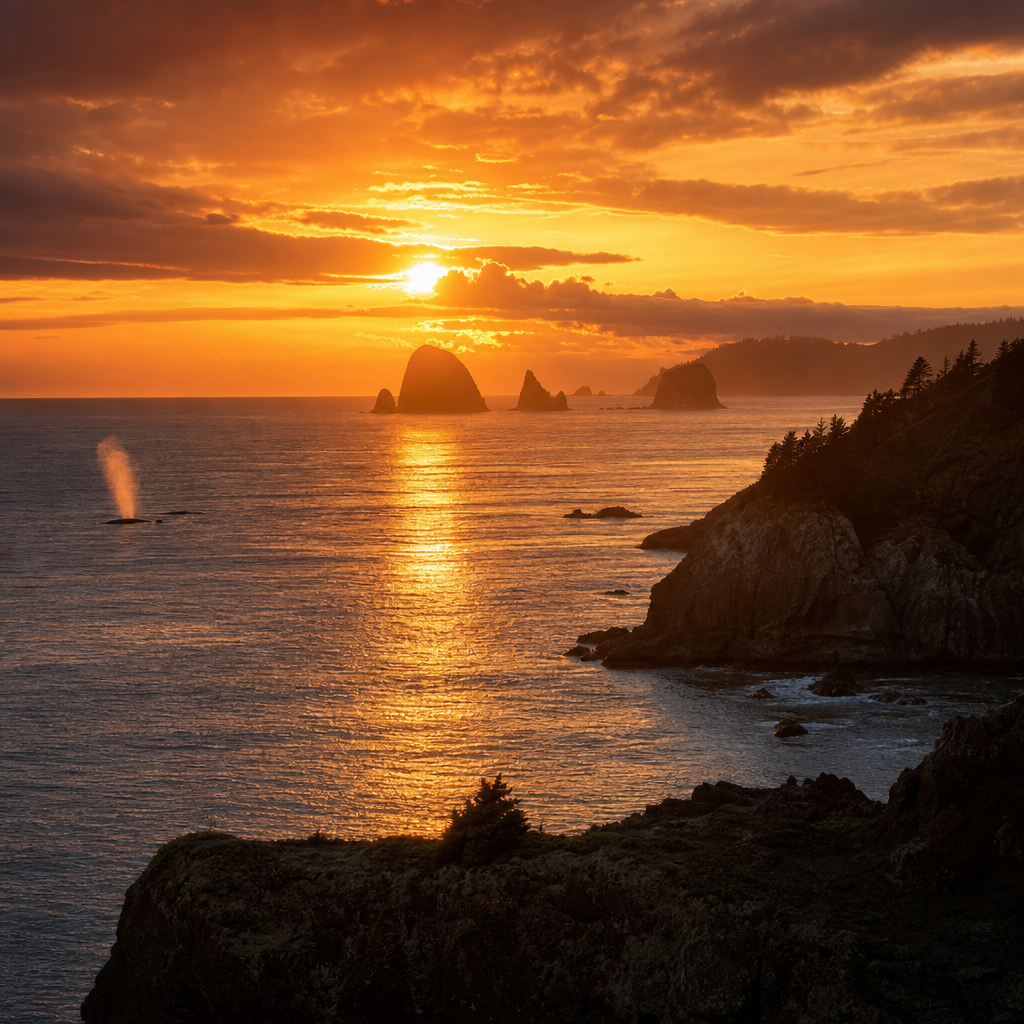
Most visitors arrive at Gold Beach expecting great fishing and jet boat rides on the Rogue River. What surprises them is the whale watching. The southern Oregon coast sits directly along the Pacific Flyway for gray whales, and Gold Beach puts you closer to deep offshore water than almost any other spot on the Oregon coast. If you have ever stood at the south jetty at sunset and watched a spout rise against a copper sky, you already know what this article is about. If you have not, this guide will make sure your first time is not wasted on bad timing or the wrong vantage point.
Table of Contents
- Quick Takeaways
- Why Gold Beach Is a Top Whale Watching Spot on the Oregon Coast
- Best Time for Whale Watching in Gold Beach, Oregon
- Best Locations to Watch Whales Near Gold Beach
- Whale Species You Will See on the Southern Oregon Coast
- Boat Tours vs. Shore Watching: Which Is Better in Gold Beach
- Whale Watching Methods Compared
- What to Bring for a Successful Whale Watch in Gold Beach
- Practical Tips for Spotting Whales from the Oregon Coast
- Frequently Asked Questions
- References
Quick Takeaways
| Key Insight | Explanation |
|---|---|
| Two peak migration windows exist | December through January for southbound gray whales, and March through April for northbound. Both are reliable from Gold Beach shore points. |
| Summer offers resident whales | A population of gray whales feeds along the southern Oregon coast from June through October, giving Gold Beach year-round sighting potential. |
| Meyers Beach is your best land-based spot | The elevated bluff at Cape Sebastian, just south of Gold Beach, provides a wide ocean sightline and is consistently productive during migration peaks. |
| Morning calm improves spotting | Whale spouts are easiest to see against a flat, glassy ocean. Early morning hours before coastal winds pick up are the most productive window each day. |
| Binoculars beat naked-eye watching by a wide margin | An 8×42 or 10×42 binocular lets you track a blow from the moment it appears, instead of scrambling to find the whale after it surfaces. |
| Rogue River jet boat tours add a unique angle | Some charter operators run ocean-going whale watch trips out of the Gold Beach harbor, combining the Rogue River estuary with offshore waters. |
| Gold Beach avoids the Cannon Beach crowd problem | During the December and March Whale Watch Weeks, Gold Beach headlands are far less congested than northern Oregon coast sites, giving you a quieter and often more productive experience. |
Why Gold Beach Is a Top Whale Watching Spot on the Oregon Coast
The geography here works in your favor. Gold Beach sits at the mouth of the Rogue River, and the continental shelf narrows significantly along Curry County. That means whales traveling the Pacific migration corridor pass closer to shore here than they do near Cannon Beach or even Brookings. The water depth drops off faster, and whales have less reason to swing far offshore.
The so-called banana belt climate of the southern Oregon coast also matters more than people realize. Gold Beach receives measurably fewer overcast, storm-locked days than communities to the north. Clearer skies translate directly into better visibility when you are scanning for spouts from a headland or a charter boat.
Gold Beach also benefits from the Oregon Parks and Recreation Department’s organized Whale Watch Weeks program, which stations trained volunteers at key coastal overlooks during peak migration. These volunteers use spotting scopes and can dramatically improve your odds of a successful sighting if you happen to visit during those scheduled weeks in December and March.
Best Time for Whale Watching in Gold Beach, Oregon
The answer is more nuanced than most travel sites admit. There are actually three distinct windows, each with different characteristics and different species behavior.
December and January: The Southbound Migration
This is the highest-volume migration. Approximately 18,000 to 20,000 gray whales pass along the Oregon coast between mid-December and mid-January, according to the Oregon Coast Aquarium. They are moving fast, traveling 75 to 100 miles per day toward Baja California breeding lagoons. Sightings are frequent, but whales are less likely to linger. Expect to see spouts, flukes, and occasional breaches from shore with no more than 15 to 20 minutes of patient scanning on a clear morning.
March and April: The Northbound Migration
This migration moves slower, and the behavior changes. Females returning north with newborn calves are especially visible because the calves travel slowly and surface more often to breathe. The Oregon Parks and Recreation Department’s official Whale Watch Week typically falls during the last week of March, coinciding with peak northbound traffic. In practice, mid-March through late April is the single most rewarding period for shore-based whale watching near Gold Beach.
June Through October: The Resident Feeding Population
A subset of gray whales, often called the Pacific Coast Feeding Group, does not complete the full migration to the Arctic. These whales spend summer feeding along the nearshore kelp beds and rocky reefs of the southern Oregon coast. Sightings during this period tend to be of whales that stay in one area for extended periods, which means if you spot one near Meyers Beach in July, it may still be there when you return an hour later.
Pro tip: Check the Oregon State Parks Whale Watching Center schedule before booking your Gold Beach trip. Arriving during an official Whale Watch Week gives you free access to volunteer spotters with high-powered scopes, which is a genuine advantage over showing up on a random weekend.
Best Locations to Watch Whales Near Gold Beach
Not all shoreline is equal for whale watching. You need elevation, an unobstructed sightline to the horizon, and enough distance from crashing surf that you can actually hear your own thoughts while scanning. These four spots deliver all three.
Cape Sebastian and Boardman State Scenic Corridor
This is the strongest shore-based whale watching location in the Gold Beach area. The bluffs along the Boardman Corridor, which stretches south of Gold Beach through some of the most dramatic headland scenery on the Pacific Coast, provide elevated viewing platforms with unobstructed ocean views. Cape Sebastian specifically is accessible, well-maintained, and consistently staffed during Whale Watch Weeks. Arrive before 9 a.m. to catch the calmest ocean surface conditions.
Gold Beach South Jetty
The south jetty at the mouth of the Rogue River is a flat, easy walk and gives you an open view both north and south along the coast. It lacks the elevation of Cape Sebastian, but it compensates with proximity to the river mouth, where whales occasionally feed on the baitfish that concentrate near estuary outflows. This is a strong option during the resident summer population period.
Cape Sebastian State Scenic Corridor
Cape Sebastian, a few miles south of Gold Beach, rises to roughly 700 feet above sea level. The elevation alone makes this one of the premier whale watching headlands on the entire Oregon coast. On a clear morning with good binoculars, you can watch whales traveling from one end of your field of view to the other. The walk to the overlook is short and manageable for most visitors.
Offshore Charter Boats from Gold Beach Harbor
If you want a closer encounter, Gold Beach’s working harbor provides access to charter operators who run ocean-going trips. Being on the water removes the distance problem entirely. Whales that appear as small spouts from shore become 45-foot animals surfacing 30 yards off the bow. The trade-off is sea conditions: the Pacific off Gold Beach can be rough, and trips are weather-dependent.
Whale Species You Will See on the Southern Oregon Coast
Gray whales are the dominant species and the reason most people plan a whale watching trip to the Oregon coast. But they are not the only option from Gold Beach.
Gray Whales
Gray whales make the longest migration of any mammal on earth, traveling up to 14,000 miles round trip between Arctic feeding grounds and Baja birthing lagoons. They are medium-sized by whale standards, reaching 40 to 50 feet, and their mottled gray skin covered with barnacles and orange whale lice makes them immediately recognizable at close range. From shore, you will identify them first by their characteristic heart-shaped blow and then by their barnacled backs rolling slowly at the surface.
Humpback Whales
Humpback whale sightings off the southern Oregon coast have increased noticeably over the past decade. These larger whales are summer and fall visitors, often spotted from Cape Sebastian and offshore charter boats between July and October. Humpbacks are dramatic surface performers. A breaching humpback is one of the more spectacular wildlife events available on the entire Pacific Coast.
Sperm Whales and Blue Whales
These are rare but documented sightings from the southern Oregon coast, typically from offshore charter boats rather than from shore. Blue whales, the largest animals on earth, occasionally pass through Oregon coastal waters in late summer. Charter boat captains who work these waters regularly are your best source of current sighting reports.
Pro tip: Before heading to the overlook, call the Gold Beach Chamber of Commerce or check in with local charter operators at the harbor. Captains who ran trips within the past 48 hours will know exactly where whales are currently feeding or traveling, which is information no website can match for accuracy.
Boat Tours vs. Shore Watching: Which Is Better in Gold Beach
This is a real question, not a false choice, and the answer depends on what you want out of the experience. Shore watching and boat tours deliver genuinely different things.
Shore watching from Cape Sebastian or Meyers Beach gives you a panoramic view of a miles-wide stretch of ocean. You can watch multiple whales moving through at the same time during peak migration. You can stay as long as you want, bring children and dogs, eat a picnic, and never worry about seasickness. The limitation is distance. Even a whale 200 yards offshore looks small from a bluff.
Boat tours bring you into the whale’s world. The sounds change. The scale of the animal becomes real. A gray whale surfacing next to a 30-foot charter boat is a different category of experience than a spout on the horizon. The limitation is that Pacific swells off the southern Oregon coast are genuine. If you are susceptible to motion sickness, come prepared with medication taken at least an hour before departure.
“The gray whales that feed along the southern Oregon coast during summer are so accustomed to coastal boat traffic that they sometimes approach vessels out of apparent curiosity. It is not unusual for a whale to surface within 50 feet of a stationary charter boat.” – Oregon Department of Fish and Wildlife, Pacific Marine Fisheries Program
A common mistake is booking a boat tour during a period of high swell without checking the marine forecast first. A 10-foot swell does not prevent whale sightings, but it does prevent enjoying them. The Oregon coast weather service provides reliable 48-hour marine forecasts and should be checked the morning of any scheduled boat trip.
Whale Watching Methods Compared
| Method | Best Season in Gold Beach | Key Advantages and Limitations |
|---|---|---|
| Shore watching from Cape Sebastian | December to April (migration peaks), June to October (residents) | Free, accessible, panoramic view of wide ocean corridor. Distance reduces detail. Best with binoculars or spotting scope. |
| Shore watching from Meyers Beach bluffs | March Whale Watch Week, December migration | Often staffed by Oregon Parks volunteers with spotting scopes. Slightly lower elevation than Cape Sebastian but excellent sightlines and easy parking. |
| Offshore charter boat from Gold Beach Harbor | June to October for resident feeders, March to April for migrating mothers with calves | Close-up encounters, local captain knowledge, ability to follow whales. Weather-dependent, seasickness risk, additional cost. Book at least one day in advance during peak season. |
What to Bring for a Successful Whale Watch in Gold Beach
Packing correctly changes the experience from frustrating to genuinely rewarding. This is not a gear list for its own sake. Each item here solves a specific problem you will encounter on the southern Oregon coast.
Binoculars
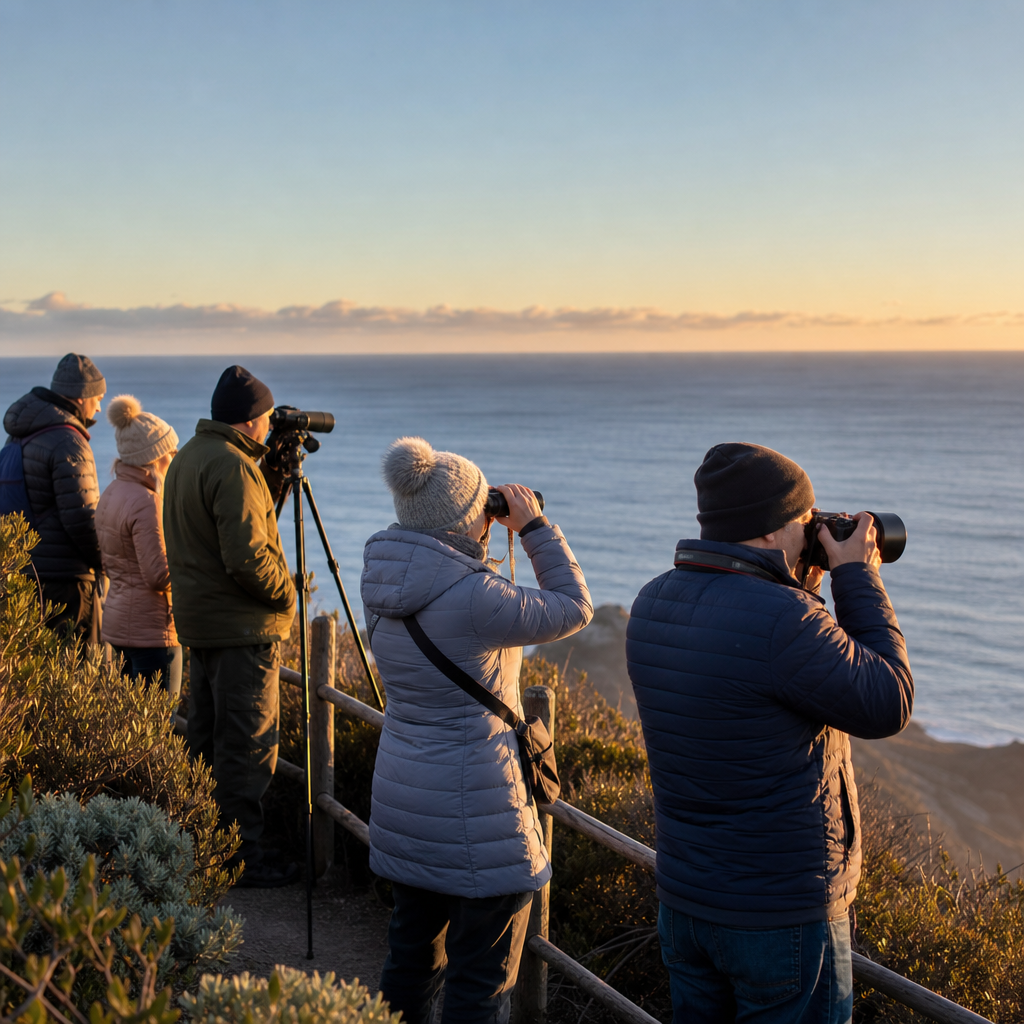
An 8×42 or 10×42 porro prism binocular is the single highest-impact item you can bring. The 42mm objective lens gathers enough light for low-angle morning sun conditions, and the magnification lets you identify a blow, track the animal’s direction of travel, and spot the gray mottled back between dives. Zoom binoculars look impressive but perform poorly in low-light coastal conditions. Bring a fixed-magnification pair.
Windproof Layers, Not Just a Jacket
Cape Sebastian and Meyers Beach headlands channel coastal wind. The temperature at the top of Cape Sebastian can feel 15 degrees colder than in Gold Beach’s town center. Bring a hard-shell windproof outer layer regardless of the forecast. Scanning the ocean for 45 minutes while cold and squinting is how people give up and miss the whale that surfaces 10 minutes later.
A Printed Tide and Weather Log
Calm mornings immediately following a high tide often produce the best visibility. The ocean surface settles after tidal exchange, and the light angle improves as the sun rises. Print the NOAA tide chart for the Port of Gold Beach before your trip. Matching your overlook visit to these windows is a simple tactic that serious whale watchers use consistently.
Practical Tips for Spotting Whales from the Oregon Coast
The most common reason people miss whales in plain sight is search technique. Most first-timers look for the whale itself. Experienced watchers look for the blow first, then the whale.
A gray whale blow reaches 10 to 15 feet high and looks like a white puff of steam against the ocean surface. On a calm morning, it is visible to the naked eye at over a mile. The moment you see a blow, note the compass direction and start counting. Gray whales dive for 3 to 5 minutes between surfacings and usually travel in a consistent direction. When you see the blow, aim your binoculars slightly in the direction the whale is traveling, and wait. It will surface close to where you are looking.
Scan systematically rather than randomly. Divide the ocean in front of you into three horizontal bands: nearshore (inside 200 yards), mid-range (200 to 800 yards), and offshore (beyond 800 yards). Spend 30 seconds on each band before moving to the next. Repeat. This prevents the natural human tendency to stare at the area where you last saw something interesting while missing activity elsewhere.
Pro tip: If you are visiting Gold Beach during the summer feeding season, ask your lodging host or a local restaurant staff member where whales have been seen recently. In a small coastal community like Gold Beach, this local knowledge is often more current than any online report and is freely shared with visitors who ask directly.
Frequently Asked Questions
When is the absolute best month to see whales in Gold Beach, Oregon?
The last two weeks of March are consistently the most productive single window, combining the peak of the northbound gray whale migration with the presence of mother-calf pairs that travel slowly and surface frequently. December’s southbound migration runs a close second for sheer whale numbers, but individual sightings from shore are briefer because animals move faster at that time of year.
Can I see whales from the beach in Gold Beach without a boat?
Yes, and in many conditions shore-based watching is more effective than a boat trip. Cape Sebastian and Meyers Beach bluffs provide elevation that allows you to spot blows at long range across a wide ocean panorama. During Whale Watch Week in March, Oregon State Parks volunteers set up spotting scopes at these locations and are genuinely helpful to first-time visitors.
How does whale watching in Gold Beach compare to Cannon Beach or Brookings?
Gold Beach offers a meaningful geographic advantage over Cannon Beach because the continental shelf is narrower here, bringing migrating whales closer to shore. Compared to Brookings, Gold Beach has slightly better access to elevated headland overlooks and benefits from the organized Whale Watch Week infrastructure at Meyers Beach and Cape Sebastian. Brookings remains excellent for summer humpback sightings closer to the California border.
What should I do if a whale approaches very close to shore?
Observe from a distance and avoid entering the water to approach the animal. Under the Marine Mammal Protection Act, it is illegal to harass, approach, or attempt to touch wild marine mammals including whales. If a whale is stranded or appears injured, contact the Oregon State Police Marine Division or the NOAA Marine Mammal Hotline. Do not attempt to push or guide the whale back to sea, as this can cause additional stress and injury.
Do I need to pay to access whale watching sites near Gold Beach?
Cape Sebastian State Scenic Corridor and Meyers Beach are both free to enter with a standard Oregon State Parks day-use pass, which costs a modest fee per vehicle. During official Whale Watch Weeks, parking and access are typically free. Shore-based watching has essentially zero cost beyond transportation and the optional binoculars you bring.
Have you spotted whales from the Gold Beach headlands or on a charter out of the harbor? Share where and when in the comments below, because local sighting reports help other visitors plan smarter trips.
References
- Oregon State University research on Pacific Coast gray whale migration patterns and population data
- NOAA Fisheries information on gray whale biology, migration routes, and Marine Mammal Protection Act guidelines
- Statista data on wildlife tourism and whale watching industry growth in North America
- National Park Service coastal wildlife viewing guidelines and best practices for responsible marine mammal observation
- Oregon Parks and Recreation Department official Whale Watch Week program schedule and volunteer spotter locations